
OFweek Laser News: In 1960, the first laser - the ruby laser - was introduced, opening the door for the research of ultra-fast processes. In 1961, the Q-switching technology was first implemented on the ruby laser, achieving short laser pulses with a pulse width of several tens of nanoseconds. The pulse width of the laser pulses was even shortened to 10 nanoseconds. The pulse width that the Q-switching technology could obtain could only reach the nanosecond level, which was due to the limitation of the laser cavity length (2L/c, where L is the resonant cavity length of the laser and C is the speed of light). In 1964, the phase-locking technology developed, forming a time-ordered multi-mode model of the laser that oscillates independently, and the mode-locking technology was first implemented on the helium-neon laser to achieve active mode-locking of nanosecond-level laser pulses. Two years later, picosecond-level laser pulse output was first achieved on the rubidium glass laser. In the mid-1960s, the development of ruby laser mode-locking and neodymium glass laser mode-locking began the research on picosecond phenomena in the picosecond time domain. In 1976, in a broadband tunable dye laser medium system, using a saturable dye absorber, sub-picosecond ultra-short laser pulses were first achieved.
In the 1980s, ultrafast spectroscopy underwent a revolutionary change. The concept of collision pulse mode-locking (CPM) introduced dye lasers, compressing picosecond laser pulses to the femtosecond (fs) time domain, generating 100 fs pulses. Subsequently, 30 fs pulses emerged. This was achieved by coupling a ring laser with a dye amplifier chain operating at a wavelength of 620 nm. The emergence of Kerr gate technology promoted the development of ultrafast spectroscopy, including ultrafast fluorescence spectroscopy. The application of chirped pulse compression technology further compressed the pulse width to 20 fs or even 6 fs. It is particularly worth noting that the titanium-sapphire laser plays a very important role in the development of ultrafast processes. Titanium-sapphire material is an important gain medium for ultra-short pulse oscillators and amplifiers, and it can output ultrafast pulses with a width of 4-5 fs at 800 nm. Materials that can achieve 20 attosecond output in the near-infrared frequency range include Cr4+:YAG, Cr3+:LiSAF, and Cr4+: magnesium olivine (M92Si04). Let's compare and estimate the energy density of femtosecond lasers: a beam with approximately 20 fs pulse width generates 1 J of energy, and the peak power density of this laser focusing reaches 1020 W/cm2.
Since the emergence of ruby lasers, with the aid of important pulse Q-switching, mode-locking and compression technologies, ultrafast processes have undergone and achieved the development of nanoseconds (1ns = 10^-9s), picoseconds (1ps = 10^-12s), femtoseconds (1fs = 10^-15s) and attoseconds (1as = 10^-18s). When stimulated by terawatts (10^12w) of laser, sub-attosecond (10^-19s) ultra-short pulse outputs can be achieved. It has been theoretically proven that if stimulated by petawatts (10^15w) of laser, zeptoseconds (10^-21s) and sub-zeptoseconds (10^-22s) laser pulses can be generated.
The key technologies of ultrafast processes - pulse Q-switching, mode-locking and compression
The so-called Q tuning refers to the technology of adjusting the Q value of the laser. In the early stage of laser pumping, the Q value of the resonant cavity is set very low, so that the laser temporarily fails to meet the oscillation conditions. When a high particle density is achieved under the excitation of the pump pulse, the Q value of the resonant cavity is rapidly increased. At this time, the reverse particle density is much higher than the threshold reverse particle density, and the laser oscillation is rapidly established and reaches a very high peak power. Meanwhile, the reverse particle density is rapidly depleted, and the pulse ends quickly. Thus, a laser pulse with a narrow pulse width and a large peak power is obtained. By using the Q tuning technology, nanosecond pulses can be generated.
Mode locking is an important technique for generating ultra-short pulses in lasers. Within the optical cavity of the laser, there are multiple modes of laser pulses. Only when the phases of these modes achieve constructive interference can laser ultra-short pulses, or mode-locked pulses, be output. Mode locking can be classified into two types: one is active mode locking, and the other is passive mode locking. The former involves periodically inputting a signal to the laser to modulate the gain or loss of the laser to achieve mode locking; the latter uses a saturable absorber (such as a thin semiconductor film) to utilize its nonlinear absorption to lock the relative phase and generate ultra-short pulse output.
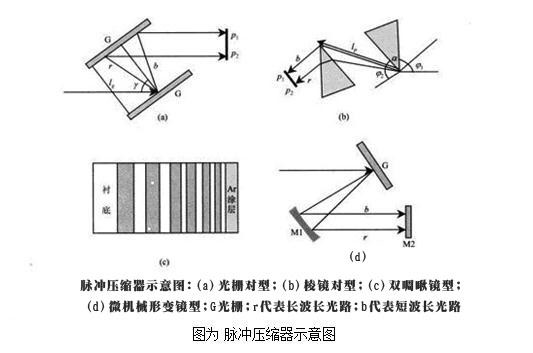
Pulse compression technology is a measure taken to overcome the dispersion effect caused by the variation of material refractive index with wavelength. If the chirp is linear, the dispersion can be easily corrected. However, most optical amplifiers are made of materials that produce high-order effects. When the pulse width increases, it is difficult to control and needs to be solved by pulse compression technology. Pulse compression technology has four basic methods: The first one is the parallel grating pair compressor. It allows the long-wavelength part of the beam to pass through a longer optical path than the short-wavelength part, thus reversing the dispersion effect of the material and becoming the grating extender of the pulse amplifier chain. This compressor introduces negative dispersion at appropriate intervals, with a compact structure but high loss (close to 50%), and it introduces high-order dispersion. The second one is the prism pair compressor. The basic principle is similar to that of the grating pair, but the negative dispersion introduced is smaller than that of the grating type. If the distance between the two prisms is large enough, the positive dispersion of the material can be balanced by moving one prism into and out of the optical path. The top angle of the prism is cut to minimize the deviation of the central wavelength, and the incident angle is a Brewster angle, minimizing the Fresnel reflection loss of linearly polarized light. The entire optical cavity system has almost no loss. It is worth noting that the grating pair compressor and the prism pair compressor introduce opposite sign third-order dispersion components. If both are used together, the high-order dispersion component terms can be cancelled. The third one is the relatively modern dual chirp mirror (DcM) compressor. The Bragg mirror is composed of alternating SiO2 and TiO2 coatings, with the refractive index of the coatings changing in a step-like manner. This structure introduces a negative dispersion relationship. The front of the mirror is like a transmission grating that generates part of the reflected light, while the back generates Bragg reflection. To eliminate the oscillation effect, the thickness of the high refractive layer is made conical, and a broadband anti-reflection layer is coated on the front of the mirror. The mirror is like a stopband filter and a reflection layer. The compressor cannot adjust the dispersion and must be manufactured according to standards and precisely cut, and it needs to be manufactured by ion beam sputtering technology, so it is quite expensive and is not widely used yet. The fourth one is the micro-mechanical deformable mirror compressor using new technologies. In addition to bandwidth-limiting pulses, active devices such as liquid crystal modulators, acoustic modulators, and mechanical deformable mirror (M2) can be used to generate complex waveforms.
The characteristics and implementation of femtosecond lasers
Femtosecond laser is a type of laser that operates in a pulsed form, with a very short duration, only a few femtoseconds. One femtosecond is 10 to the power of minus 15 seconds, which is 1/1000 trillion seconds. It is thousands of times shorter than the shortest pulse obtained using electronic methods and is the shortest pulse that humans can achieve under experimental conditions. This is the first characteristic of femtosecond laser. The second characteristic of femtosecond laser is that it has an extremely high instantaneous power, reaching up to 100 trillion watts, which is more than 100 times the total power of all the electricity generation in the world. The third characteristic of femtosecond laser is that it can be focused to a space area smaller than the diameter of a hair, making the intensity of the electromagnetic field several times higher than the force exerted by the atomic nucleus on its surrounding electrons.
How are these characteristics of femtosecond lasers achieved? The high-power femtosecond laser system consists of four parts: oscillator, broadener, amplifier and compressor. In the oscillator, a femtosecond laser pulse is obtained using a special technique. The broadener spreads this femtosecond seed pulse over different wavelengths in time. The amplifier gives this broadened pulse sufficient energy. The compressor reunites the different spectral components of the amplified light back together, restoring it to the femtosecond width, thereby forming a femtosecond laser pulse with extremely high instantaneous power.
Femtosecond lasers have been widely applied in various fields such as physics, biology, chemistry for controlling reactions, and optical communication. Particularly noteworthy is that due to the rapid and high-resolution characteristics of femtosecond lasers, they have unique advantages and irreplaceable roles in the early diagnosis of diseases, medical imaging and biological in vivo detection, surgical medicine, and the manufacturing of ultra-small satellites.