
OFweekLaserNews: Since Google's self-driving cars went viral in 2012, the "family bucket" mounted on car roofs has always been so eye-catching. And this "family bucket" is the legendaryLidar。
The supplier of this LiDAR is Velodyne from the United States. At that time, this "full package" cost as much as $70,000, which was even more expensive than the car itself! To be precise, it could buy 5 BYD cars...
OK, speaking of which, everyone must be wondering, the term LiDAR seems to be mentioned quite frequently lately, right?
Exactly, when it comes to LiDAR, we can't ignore the currently trending ADAS. At this stage, LiDAR, millimeter-wave radar, and visual sensors are the mainstream methods for environmental sensing around vehicles, essential for achieving ADAS.
The so-called LiDAR is a technology that utilizes laser beamsto detect targets, acquire data, and generate precise digital elevation models. Its working principle is also easy to understand: it emits and receives laser beams. Inside the LiDAR, each set of components includes both a transmitter and a receiver. Let's take the rotating mirror design from Velodyne, the most renowned company in the LiDAR field, as an example.
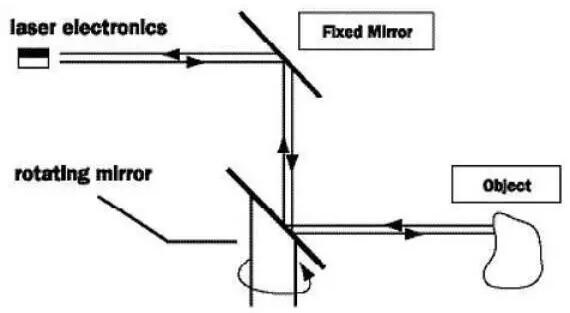
This set of transmitting/receiving components combined with a rotating mirror can scan at least one plane. The mirror not only reflects the light emitted by the diode but also redirects the reflected light back to the receiver. By rotating the mirror, a field of view ranging from 90 to 180 degrees can be achieved, significantly reducing the complexity of system design and manufacturing, as the mirror is the only moving part in the entire setup.
The principle of detecting distance is based on the time it takes for the light to return,Laser Diodeemits pulsed light, which reflects off the target object and returns partially. A photon detector installed near the diode can detect the returning signal. By calculating the time difference between emission and detection, the distance to the target object can be determined. Once activated, the pulsed distance measurement system can collect a large number of point clouds.
If there is a target object in the point cloud, it will appear as a shadow within the point cloud. This shadow can be used to measure the distance and size of the target object. The point cloud can generate a 3D image of the surrounding environment. The higher the point cloud density, the clearer the image.
After explaining the principle of LiDAR, comrades might still have questions: Why are two types of radars installed in ADAS, and what are the differences between LiDAR and millimeter-wave radar?
Our editor has specially prepared a chart comparing the capabilities of LiDAR and millimeter-wave radar in various aspects, making it clear at a glance:
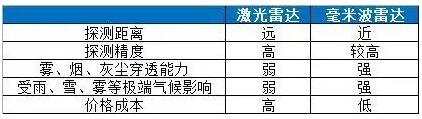
Overall, LiDAR offers higher precision but comes with a higher price tag.
The advantages of LiDAR are quite evident—it boasts a wider detection range and superior accuracy. However, its performance significantly degrades in extreme weather or smoky conditions. Additionally, due to the massive volume of data it collects, it is also very expensive. For instance, the 64-line LiDAR (where more lines equate to better performance and higher cost) currently installed on Baidu and Google's autonomous vehicles costs as much as 700,000 RMB.
Millimeter-wave radar is constrained by wavelength but is more affordable.
Millimeter-wave radar technology is relatively mature, operating at wavelengths between centimeter waves and light waves. This gives it the combined advantages of microwave and photoelectric guidance, along with compact size, lightweight components, and high spatial resolution. Moreover, millimeter-wave radar excels in penetrating fog, smoke, and dust—a major advantage over LiDAR. However, due to direct limitations from frequency band attenuation, it cannot precisely model all surrounding obstacles. That said, thanks to its mature technology, its unit cost is lower, around just $100, and market demand for it is higher compared to LiDAR.
To complement each other, most ADAS systems are equipped with two types of radar. However, to promote ADAS and achieve the grand vision of autonomous driving,Lidarthe cost issue becomes critical. Imagine,Lasera radar that costs more than the car itself—would any customer be willing to pay for it?
So, everyone is looking for ways to reduce the cost of LiDAR, and then! Solid-state LiDAR was born!
Solid-state LiDAR first appeared in the public eye probably at this year's CES in January. The LiDAR startup Quanergy Systems announced what it claimed to be the world's first solid-state LiDAR sensor, stating that if the order volume reaches 10,000 units, the cost per LiDAR could potentially be controlled below $100. (We will provide a detailed introduction to this company later, so no need to rush to Baidu it.)
$100, what a concept... Something that used to cost hundreds of thousands is now just a few hundred bucks! What on earth did they do to bring the cost down so dramatically?
We need to return to the fundamentals. Traditional LiDAR operates through 360-degree mechanical rotation, whereas solid-state LiDAR employs an electronic component-based solution for data reading and writing, eliminating mechanical rotating parts. It uses sensing chips on integrated circuits to scan in all directions and then outputs a 3D image of the vehicle's surroundings. Additionally, Quanergy has reduced the number of laser lines to just 8, significantly cutting costs while also minimizing the device's size.
To explain it with a simple and easy-to-understand diagram, it would look like this:
However, "solid-state" means the LiDAR cannot rotate 360 degrees and can only detect objects in front. But this limitation in detection range can be addressed by installing multiple units on the vehicle.
In addition to solid-state LiDAR, there is currently a hybrid solid-state radar, which is another transitional product. Although the hybrid solid-state radar does not visibly show the rotating mechanism of traditional LiDAR, it still contains some mechanical rotating components inside to achieve a full 360-degree field of view. The only difference is that these mechanical parts are made very compact and hidden within the device.
Nevertheless, while the above two solutions have reduced the cost of LiDAR, they still cannot solve the issue of performance degradation under extreme weather conditions. Therefore, ADAS still needs to combine LiDAR with all-weather millimeter-wave radar to ensure detection performance in all environments.
After discussing various aspects of LiDAR, let's take a look at some of the most representative companies in the LiDAR field.
Velodyne
When it comes to LiDAR, Velodyne is a name that can't be overlooked! Remember the KFC family bucket worth hundreds of thousands mentioned at the beginning of the article? That was their product.
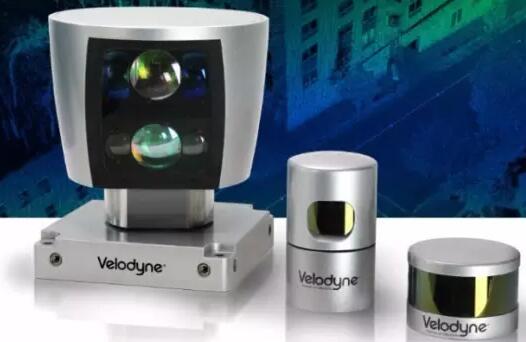
Velodyne currently mass-produces and sells LiDAR (image from Velodyne)
Founded in Silicon Valley, USA in 1983, the company began developing LiDAR in 2005, primarily for applications in autonomous vehicles. By 2007, it emerged as a developer, manufacturer, and supplier of real-time LiDAR sensor technology. In 2009, Google launched its autonomous car project using Velodyne's extremely expensive LiDAR, which significantly boosted Velodyne's reputation. In 2016, Velodyne spun off its LiDAR division to establish Velodyne LiDAR, and it was this new company that secured a $150 million investment from Ford Motor Company and Baidu this year.
Velodyne currently has three models of LiDAR in mass production and sales: HDL-64E (64-beam), HDL-32E (32-beam), and VLP-16 (16-beam). Apart from companies like Google, Baidu, and Uber using the 64-beam product for autonomous vehicles, some automakers are testing the 32-beam and 16-beam products in their cars.
You may wonder why their products are so expensive.
The primary reason for the high price is thatLidarthey are far from reaching large-scale application. Moreover, Velodyne's factory in the Bay Area is still in the manual assembly and calibration stage, resulting in very high labor costs. %%
Taking the calibration of a 64-line radar as an example, each line is equipped with a pair of laser transmitters and receivers: rotating at a speed of 20 revolutions per second, the emitted laser must reach distances of 100 to 200 meters. During the assembly process, to ensure the transmitted laser is accurately received by the paired receiver without any deviation, the production is extremely meticulous. Under these conditions, only two finished units of 64-line radar can be completed in a week. Such assembly and calibration processes are incredibly complex and time-consuming.LaserTaking the calibration of a 64-line radar as an example, each line is equipped with a pair of laser emitters and receivers: rotating at a speed of 20 revolutions per second, the emitted laser must reach a distance of 100 to 200 meters. During the assembly process, to ensure that the emitted laser is accurately received by its paired receiver, no deviation is allowed. Under these conditions, only two finished products can be completed per week for a 64-line radar. This assembly and calibration process is extremely complex and time-consuming.
However, their situation is expected to improve this year as Velodyne plans to outsource production to leading Chinese OEM manufacturers.
Quanergy
Quanergy gained fame by unveiling "the world's first solid-state LiDAR for autonomous vehicles" at the CES consumer electronics show earlier this year, and claimed to reduce the price of LiDAR products to around $100.
Founded in 2012, it's a startup focused on LiDAR development. As a company less than four years old, it has already attracted attention from venture capitalists and automotive parts giants:
In 2014, it received seed investment from Samsung Venture Investment, Tesla founder, and Tsinghua Entrepreneurs Angel Fund; completed a $30 million Series A financing in the same year; in 2015, it secured strategic investment from Delphi, which acquired a portion of Quanergy's equity, and engineers from both companies are currently working hard to develop the LiDAR system; in 2016, it raised $100 million in Series B financing.
Currently, they are collaborating with Delphi Automotive on product development, but mass production is still two years away...
Ibeo
Ibeo, based in Hamburg, Germany, is actually no newcomer in the lidar field. Founded in 1998, it was acquired by sensor manufacturer Sick AG in 2000. The company became independent from Sick AG in 2009 and partnered with Valeo in 2010 to begin mass production of the automotive-grade product ScaLa. This year, automotive parts supply giant ZF acquired a 40% stake in Ibeo. The two parties will collaborate to develop next-generation lidar, which is also expected to be solid-state lidar.
After discussing so many foreign companies, have there been any breakthroughs by domestic enterprises in this area?
It's quite unfortunate that the core technologies of lidar are still largely in the hands of foreign companies. Currently, there are about 10 domestic enterprises working on lidar, but most focus on atmospheric pollution detection and 3D mapping. Only a few specialize in automotive lidar R&D, mainly including Escort Industry, LeiShen Intelligent, and Slamtec. Due to technical limitations, domestic lidar companies generally lack a strong voice in the autonomous driving sector, which poses many challenges for domestic autonomous driving R&D and industry ecosystems. For startups looking to enter this field, they must consider how to reduce costs while maintaining detection accuracy to stand out in the market.